How we changed what the market thought about a declining brand
MPS Limited acquired HighWire Press in 2020. On paper, a textbook play: MPS sells content solutions to the research market, HighWire hosts research content for the same market. Allied solutions. Same buyers. Obvious cross-sell. Plus the margins of a B2B SaaS business.
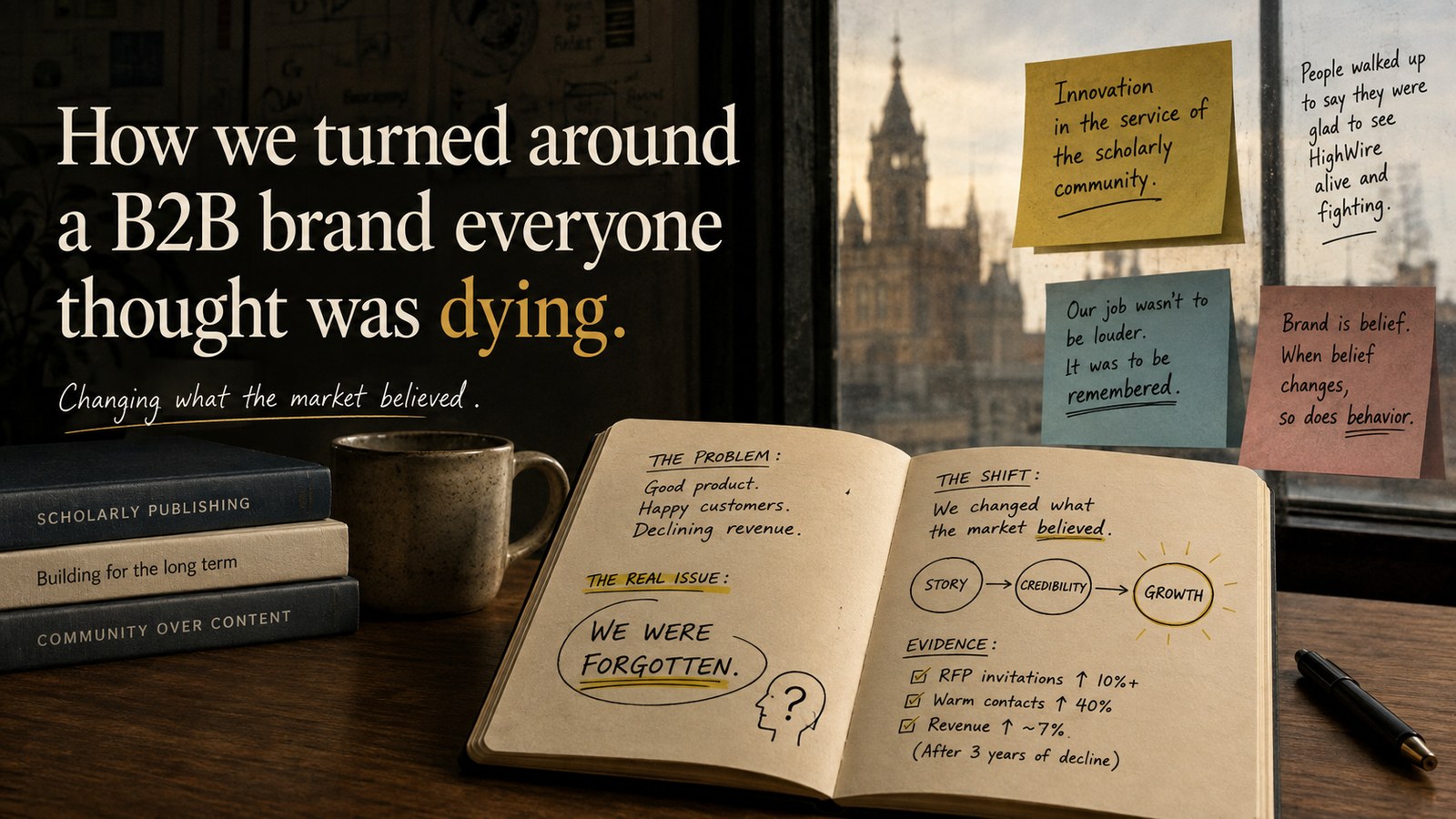
The first three years didn’t cooperate. Churn ran well above normal SaaS levels, and revenue declined three years straight.
Leadership responded by looking inward. They invested in the product, smoothed out delivery, and built a customer success team to catch problems before they escalated. It worked. Churn slowed and relationships recovered.
But new business didn’t follow. New logos were rare. MPS is a respected name in this industry. So why wouldn’t buyers trust HighWire under its banner?
I took over the brand in 2023, fresh out of b-school and eager to make a mark. HighWire was the first brand I ever managed (it’ll always be close to my heart). I read the numbers, read the history, and spoke to everyone who’d talk to me.
What I found: our leaders were excellent, but they were solving one half of the problem. They had fixed product, support, and relationships; all of which our existing customers could see. To everyone outside that customer list, we were dead.
The perception problem
HighWire pioneered scholarly publishing online. In 1995, John Sack set out to build a community of scholarly enthusiasts and make research accessible beyond print journals sitting in university libraries. People joined because they believed in that. In the early 2000s, HighWire was the industry stalwart.
Over the years the mission faded from view. HighWire became just another hosting provider, and eventually, in the market’s mind, a legacy one that couldn’t keep pace with modern research.
That was the aha moment. We had no distinct perception, so we were easy to forget. Our HighWire story was the problem.
A story that already had a strong title (brand tagline): innovation in the service of the scholarly community. My job was to craft a story that aligned with the title and made it all convincing.
Earning “community”
John Sack is still one of the most respected people in this industry. Working with my product head, I got John into an interview with Heather Staines, senior consultant and director of community engagement at Delta Think. John talked about why he founded HighWire and what still drives him.
That was the second half of the tagline: “service of the scholarly community”, told by someone who had been serving the industry for over 3 decades.
Earning “innovation”
The first part of the tagline, “innovation”, now needed proof. And it sat inside the company. MPSLabs: MPS’ AI research lab, now 300+ engineers. I sat with its head to understand what they were actually building, then started putting those features and updates in front of the market.
The new customer success team turned out to be my best collaborators. They helped me build customer stories about real problems we’d solved with technology, including customizations other vendors wouldn’t touch. Add metrics like 99.8%+ uptime and 8M+ monthly page views, and “innovation” stopped being a claim.
Now I had the story. It needed to reach the right people.
Distribution
Industry voices. The interview went on our site and YouTube. John shared it. Heather shared it with her 9k LinkedIn followers. Delta Think shared it. A respected consultancy talked about us without us spending a penny, entirely on goodwill and John’s social currency. I then pitched the story to Scholarly Kitchen, ALPSP, Information Today and others. Several ran it.
That mattered more than the view counts suggest. In this industry, publishers ask consultants who they should be talking to. When a consultant knows what you can actually do, your name comes up in rooms you are not in. Those relationships, with Delta Think and with firms like Maverick and Clark & Esposito, became one of the most durable things we built.
The newsletter. We had 5,000+ people who had opted in to hear from us and had received nothing, because we published nothing. Search data showed 2k+ impressions for “highwire newsletter”: people were actively looking for something that no longer existed. So I brought it back: blog posts, case studies, events, webinar recordings. Even at a rough ~20% open rate before any list cleanup, that was 1,000 people a month who could see we were alive. They forwarded it to colleagues, who subscribed. The list grew past 7,000 in two years.
Social, where the audience actually was. HighWire posted twice a week on LinkedIn: one product promo, one event plug. I brought in an agency, moved to three or four posts a week, cut the promotions, and shifted the weight to thought leadership. Relevant people started following. When the research community began migrating from X to Bluesky, we moved with them. No promotions, no fluff, no pretending to be researchers. A brand that respects your space and shares things you might actually want to read.
What happened
Revenue grew ~7% after three years of decline. I can’t tell you how much of that was positioning. The delivery and success teams had been fixing churn since before I arrived, and that work was already paying off. What I can say is that new logos started showing up again, and they hadn’t for three years.
RFP invitations rose more than 10%. In scholarly publishing, you don’t apply for RFPs. Instead publishers decide who gets invited to bid. Being in that room at all is a function of whether the market thinks you’re a serious player. That’s the metric I care about most, because it’s perception converting directly into pipeline.
Warm contacts grew 40% in two years, in a market that rewards patience. I never ran a monthly cold blast. People wanted to hear from us.
The line I remember best came secondhand, from my leadership: people were walking up to them at events to say they were glad to see HighWire alive and fighting.
I came away from HighWire with a slightly different view of brand. I used to think of it as the thing that makes a company look different. At HighWire it was closer to the thing that helps the market notice a company has changed.
HighWire stays close to my heart because the brand stood for a mission, and marketing turned out to be the thing that could carry that mission to the people who cared. I was given the resources to do it, and I was in the right place at the right time.

Related Posts
A product name has to survive being said out loud