A product name has to survive being said out loud
I cannot use the real product names here, or say how they performed. So the example below is invented — but it is built exactly the way the real ones were, and it fails in exactly the same places.
Most naming advice is about meaning. Does the word say the right thing, does it feel like the brand, does it have the right associations. That is the enjoyable part, and it is the part that gets all the attention.
Names rarely fail there. They fail somewhere much more boring: in a noisy room, in a browser address bar, three weeks after anyone heard them.
A name that does everything right and still fails
Say you are launching a VPN for an Indian audience. You want a name that signals privacy in a language your buyers actually think in.
Purdah. A curtain. The thing placed between you and being seen. It is a genuinely good word: short, evocative, and it means precisely what the product does.
purdah.com is taken.
So you try the next spelling.purda.com is taken too.
So you try one more.You settle on Parda.
And you set पर्दा alongside it in the launch material, so the meaning is unmistakable.Every one of those decisions was reasonable on its own. Here is what you have bought.
It reads like a misspelling of Prada. Not a disaster, but every first impression now carries a half-second of confusion you have to spend budget correcting.
You spell it out at every conference. Someone asks what you do, you answer, and they say “sorry, how do you spell that?” Every time. That is not a branding problem, it is a tax on every conversation you will ever have about your own company.
And then the real damage. Three weeks later one of those people is ready to buy. They remember the meaning, not your spelling. They type the word they heard — purdah — and they land on your competitor’s website.
The domain search did not inform the naming decision. It quietly became the naming decision.
That is the trap. Nobody sits down and chooses a name that leaks leads to a competitor. You arrive there one small, defensible compromise at a time, and the compromises compound out of sight.
What I check now
Underneath all five is one preference I would defend anywhere: short, and memorable. Everything else is recoverable with money. Those two are not.
The best names do two jobs in one word. I like a name that carries a functional term the industry already uses and a warm, familiar word from the language the buyer speaks — so it is precise to an expert and human to everyone else. That is rare, and worth holding out for.
The check that is on nobody’s list
There is a sixth one I only learned by watching it go wrong: does the name tell the truth about how big the change is?
Version suffixes are the usual culprit. Adding Pro, or Plus, or a number, tells the market you have shipped an increment. If what you have actually shipped is a different category of product — if you went from a tool that handled one step to a system that handles the whole workflow — then the name is arguing against your own positioning, in every document, forever.
I caught myself on the receiving end of this recently. Anthropic released Claude Opus 5.5, and I did not go and read what had changed. I had used Opus 5. I assumed I knew what it could do. I was wrong — but nothing in the name suggested I should look again, and in a category where something new launches every week, a decimal is an invitation to skip.
That is not a complaint about the product. It is an observation about what a version number can and cannot carry, from someone who ignored one.
A name cannot make a small change feel big. But it can absolutely make a big change feel small, and that is a self-inflicted wound.
When the name is not yours to choose
Much of the naming advice written for marketers assumes you hold the pen. Often you do not. The name arrives already decided — from a founder, from an acquisition, from a decision taken long before you joined — and your job starts after it is settled.
That is not a reason to sulk about it. It is a different brief, and a legitimate one: not what should this be called, but what is the fastest way to make this name legible?
The most useful tool there is borrowed convention. If a name follows a pattern buyers have already learned somewhere else — a suffix they associate with cloud software, a construction they have seen on products they already pay for — you can lean on that association hard, and let it carry the explanation you would otherwise have to fund. It is not the name you would have chosen. It can still be made to work.
What you cannot do is quietly hope the market will work it out. A name you did not choose still needs somebody to decide what it means. If that is not you, it is nobody.

Related Posts
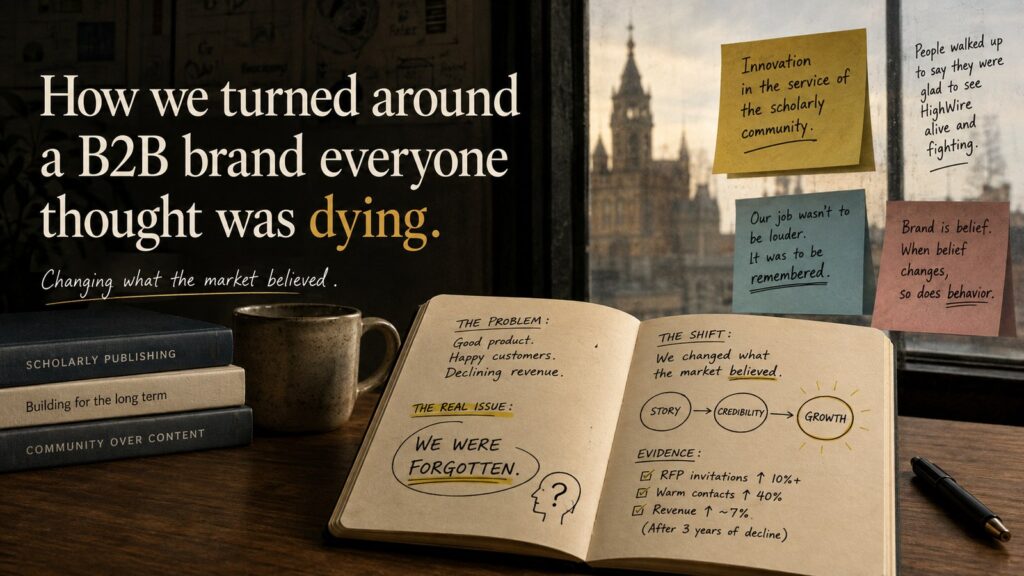
How we changed what the market thought about a declining brand